Book Reviews

Book Review: Mary and Philip: The Marriage of Tudor England and Hapsburg Spain

In Mary and Philip: The Marriage of Tudor England and Hapsburg Spain, Alexander Samson sets out to achieve a dense amount of goals based on the perceived success and failures of the marriage of Mary Tudor and Philip of Spain. This book not only covers the failures of the marriage through discussions of existing historiographical research on the topic, but Samson brings his own ideas of the consequences of this marriage to the playing field. In the introduction, he stated that he hopes to provide a balanced view of the impacts this marriage had on the British Empire and the rest of Europe. Alexander Samson is an intellect with a wide background. He has focused his career on the colonial history of the Americas, Anglo-Spanish intercultural relations, and Early Modern English and Spanish drama. He does not focus specifically on Early Modern England, which may lead to some skepticism on his qualifications to write such a niche topic book. However, his diversity of experience within the field may allow him to bring in ideas and evidence not usually used by historians within this topic. Overall, Samson surveyed the reaching impacts and dynamics of this marriage along many different intersections. Readers should leave this book feeling slightly overwhelmed with information, but having new thoughts about the marriage of Mary and Philip. 


The book starts off with an introduction where the author takes readers through a detailed overview of the various opinions through the historiography of Mary and Philip. He sets up this chapter so that at the end he can state his goal for the book. Throughout the introduction, the author seems to have an ambitious purpose in mind. Overall, the goal of the book is to provide a balanced analysis of the impacts and dynamics of the Mary and Philip marriage. Some of the main themes he brings up are economic and commercial links between England and Spain, the ceremonial and material culture of royal marriages, the skepticism surrounding a female ruler, revolts against Mary’s reign, xenophobia, hispanophobia, and the power dynamics between the king and the queen. By analyzing all of these things he paints a new picture of how the couple was perceived in an economic, political, and cultural sense around Europe. 


Chapter 1 The Prenuptial takes readers through the political and economic situation of England right before Mary was crowned queen. It is argued that one of the main reasons for setting up the Marriage between Mary and Philip was to keep the Channel open for trade and decrease the threat of the French. This goal was always in the back of the mind of the two countries as Edward VI decreased in health. This chapter also focuses on the symbolism within the coronation of Mary Tudor. She was given material symbols of both King and Queen and was triple crowned with Henry VIII’s Imperial crown. The three-tiered crown was supposed to represent the universal catholic jurisdiction of the pope. Chapter 2 goes through the difficulties of outsider opinion the couples faced as they were contracting their matrimony. Some of these issues included xenophobia, anti-Spanish sentiment, gender expectations of a ruler, betrayal, and Mary’s catholicism. Much of this suspicion came from England’s lack of experience with female rulers, while Spain had had much experience with female and foreign rulers. Chapter 3 goes over Wyatt’s revolt and the Act for the Queens Regal Power. In a way, these two events are connected. Many people within England did not think that as a female Mary had the right to rule, which sparked many revolts when she was coronated. Consequentially, the Act was passed stating that Mary possessed all the same powers as ruler as the kings that had followed her. Although there were many doubters throughout the realm, it cannot be assumed that everybody felt this way about her. Chapters 4 and 5 talk more about the symbols seen by the people throughout Mary and Philip’s marriage that alluded to their power dynamics. For example, on their wedding day, they each wore almost identical outfits and Mary was seated on the right side of Philip, the side usually reserved for the King or the Male. Chapter 6 dives deeper in xenophobia and hispanophobia. The author attempts to argue that the xenophobia of the time did not negatively impact Anglo-Spanish relations. Xenophobia and Hispanophobia were largely confined to the London area, and usually only existed out of economic jealousy. Chapter 7 analyzes how the government functioned under Mary and Philip, as well as explores the misogynistic opinions often aimed at Mary. 


This book has some strengths and weaknesses as to how the author went about proving his point. First, the idea of this book is quite unique in the historiography of the topic. The author set out to change how historians, and possibly normal people view the marriage of Mary and Philip. It was very nice how Samson laid out the overall feeling of historians towards Mary and Philip in the beginning of the introduction. He took readers through a summary of what has already been said about the successes and failures of this marriage. Additionally, the end of the introduction where the author very clearly lays out his arguments was helpful for the reader to get an idea of his goals. The author also used a variety of sources to help him write this book, which he pulled into his writing quite often. There was never a statement made by the author that wasn’t lacking an example. Lastly, the author did an amazing job of using intersectionality to examine this marriage. Not only did the book look at gender, but it also looks at the racial, ethnic, economic, and political aspects of this marriage. Even the author’s analysis of the material symbols such as clothes and crowns used in the coronation and wedding helped readers to envision the power dynamics of the couple. 


In terms of weaknesses, this book lacked a streamline organizational system which made it hard for readers to connect his evidence to his main purpose. The first example of this was the introduction where he dove immediately into anlyzing the current historiography of Mary and Philip. It took him far too long into the introduction to state his point. Secondly, the chapters did not seem to be organized in a specific way. Although the titles of the chapter led readers to believe it would talk about a certain theme, the end of the chapter would stray away from that idea. Within the chapters, there was a lack of connections to his main points and purpose. He would sometimes get so caught up in providing details, evidence, and examples that he would forget to remind the readers how these points connect to the main goal. The previous point can be seen as a strength or a weakness depending on your reading skill/style. Lastly, this book was definitely meant for more of an academic audience. Better organization, concise writing, and purposeful statements might have made this book more suitable for the average reader.
 

The Tudor Occupation of Boulogne: Conquest, Colonisation and Imperial Monarchy, 1544-1550

Neil Murphy. The Tudor Occupation of Boulogne: Conquest, Colonisation and Imperial Monarchy, 1544-1550. Cambridge: Cambridge University Press, 2019. Hardback


Murphy is a professor of Medieval and Early Modern France, emphasizing the reign of English King Henry VIII. In The Tudor Occupation of Boulogne: Conquest, Colonisation and Imperial Monarchy, 1544-1550, Murphy argues that the English occupation of the Boulogne region in France was a significant shift in the imperial history of England. Murphy is filling a spot in the scholarship of empire building in Early Modern England. Murphy argues, “First of all, rather than view the establishment of colonies in the midlands of Ireland in the mid-sixteenth century as marking the beginning of a nascent British Empire, we should consider them concerning Henry VIII’s actions in France in the 1540s.” (230) Murphy argues that the study of the English Empire glosses over their actions in Northern France in the 1540s and starts with expanding into Scotland and Ireland in the 1570s. Murphy also points out that the English invasion of Boulogne differed from previous monarch’s wars in France due to Henry VIII not claiming his right to the French throne, but instead claiming the land by right of conquest. 

King Henry VIII invaded the Boulogne region in North-East France in 1544 and proceeded to Anglicanize the region. The population was deported from the area by the king, and English subjects were brought in to populate the now vacant land. The region was placed under English law and officially became English land rather than an English possession in France. The occupation and subsequent repopulation of Boulogne by the English was a major change in the English attitude towards territory outside of England proper. Before the invasion of Boulogne in 1544, English kings would justify an invasion of France by claiming the French throne. The English king would have to win over the population of France to support their adventure and occupation of land in France. Henry VIII, however, did not need to win over the population because he would import his population of English citizens into the region. 

Murphy spends a significant chunk of the book explaining the actions taken by Henry VIII in Boulogne and how those actions foreshadowed those that were taken in Ireland and Scotland by the British decades later. Actions such as the violence and the military action that Henry VIII used to conquer the region. The English army that Henry VIII assembled for the conquest was the largest force that England had amassed up to that point. The violence that came with the attacks was not uncommon according to standards of war at the time. However, the violence was uncommon when it came to the English invading France. As Murphy notes, “As we shall see, the killing of peasants, scouring of woods, burning of houses and destruction of crops to create famine conditions amongst a people the English deemed to be rebels were all measures Henry VIII had implemented in the Boulonnais in the 1540s, almost seven decades before Mountjoy laid waste to Ulster.” (2) English violence during a period of conquest was not a unique phenomenon, but the English had before been attempting to win over the native population in France to lay claim to the crown. Henry VIII abandoned that idea and set about to occupy the French lands as their conqueror and not their king. 

The subsequent paragraphs explain how the English conquered their newly acquired land. Henry VIII forced out the French peasants and brought in English peasants to populate the land. Bringing in English subjects made it easy for English laws and customs to be adopted. Henry VIII broke from traditional war aims and turned the newly conquered land in France into English land with English laws and subjects. 

Murphy’s intended audience is an academic one. He provides archival sources and primary sources that could be hard to understand for someone who does not understand the period. Many of the archival sources are written in English; however, their form of English is different and makes some of the sources challenging to understand. Murphy uses archives, primary printed references, and secondary printed sources to build his argument and weaves them together eloquently. One downside that the sources have is that Murphy uses a large number of secondary sources. He wraps his major argument around archival sources but more primary sources would have strengthened the argument. 

The book overall has many strong points. The argument is original and sets itself firmly within the field of Early Modern England. Murphy is filling a gap in the historiography and is challenging other scholarship that has been created surrounding the early British Empire. The previous historiography has placed English holdings in France and English conquests of Ireland and Scotland as distinctly different. They point out that the violence and occupation of Scotland and Ireland were unique to the region and started the first steps for the English Empire. Murphy, on the other hand, argues that English holdings in France were the beginning of England expanding outside its borders for the sake of claiming territory. The English expansion into Northern France was the first step for the English to create an empire that would span across oceans. Before England expanded into Scotland and Ireland, Henry VIII experimented with colonial conquest in Northern France. 

The Tudor Occupation of Boulogne: Conquest, Colonisation and Imperial Monarchy, 1544-1550 by Neil Murphy is a wonderful book that argues against the previous historiography and creates an original argument. Murphy has created a new argument that predates the conventional starting point of the English Empire. The Tudor Occupation of Boulogne is a must-read for anyone who is studying Early Modern England or the English Empire. Murphy challenges conventional historiography and treads into uncharted territory and delivers an original argument that is delivered with eloquence. Murphy uses archives, primary sources, and a large number of secondary sources to build his argument and writes in a clear manner that allows anyone to read. Without background knowledge of England in the early modern period, a reader can still understand his argument and its impact on historiography. 


Reviewed by Tyler Thompson, Graduate Student at George Mason University. 

Tudor Occupation of Boulogne: Conquest, Colonisation and Imperial Monarchy, 1544-1550: Review

Murphy, Neil. The Tudor occupation of Boulogne: conquest, colonisation, and imperial monarchy, 1544-1550. Cambridge. Cambridge University Press. 

Published in January 2019

https://doi-org.mutex.gmu.edu/10.1017/9781108653046


When you think of Early Modern England and what family was responsible for stabilizing and growing England into a global empire, the Tudor family is that family. In Neil Murphy’s The Tudor Occupation of Boulogne: Conquest, Colonisation, and Imperial Monarchy, 1544-1550. Murphy examines and analyzes the occupation of Boulogne under the rule of King Henry VIII which would start British Imperialism. Neil Murphy is an associate professor of History at Northumbria University in Newcastle, England and is the author of three books. The Captivity of John II, 1356-60: The Royal Image in Later Medieval England and France (2016), Ceremonial Entries, Municipal Liberties, and the Negotiation of Power in Valois France, 1328-1589 (2016) and The Tudor Occupation of Boulogne: Conquest, Colonisation, and Imperial Monarchy, 1544-1550 (2019). Which is his latest published book.  Murphy specializes in Medieval and Early Modern France.

Neil Murphy’s book The Tudor Occupation of Boulogne: Conquest, Colonisation, and Imperial Monarchy, 1544-1550. He analyzes and examines historical data on Henry VIII’s occupation of Boulogne and how it impacted the Boulonnais people and the economics of the area. The occupation and colony in Boulogne is/was one of his most significant ventures despite not getting much attention. Henry VIII’s occupation in France and the way that he handled the conquest would lay the groundwork for future English occupations such as Ulster. “David Potter has provided a thorough study of the organisation of the war between Henry VIII and Francis I in the 1540s, though he does not deal with the nature of English rule at Boulogne and usually focuses instead on the religious change that occurred under his children, ignoring the final years of his reign.”1 When you think of Henry VIII; you think about his children and the fact that he had six wives His examination of the occupation of Boulogne gives us an insight into a military occupation that is rarely talked about when you discuss the Tudor dynasty and how it ties into the Early Modern England period that we are talking about in class 

Murphy relies on and ties in several historical evidence that supports the two arguments that are discussed in each chapter. In the first chapter, King Henry VIII is starting his venture into Boulogne, where he will establish a colony. The only prior knowledge that I had of Boulogne was what William Palmer had to say about the conquest, having previously learned about the conquest when I was in high school. Murphy argues that the conquest was not a waste of millions but instead a sign of what was to come for the future of imperialism in England, that what happened in Boulogne served as a sort of blueprint to the future of England under the Tudors. The occupation of Boulogne was not seen by everyone as a success or even necessary. William Palmer called it a “useless military endeavor that cost £1,000,000” and Bruce Lenam said that that “he [Henry VIII] was pouring millions into a futile bid to re-create the Anglo-French empire of Henry V’ and placing his government ‘deep into debt in pursuit of strategic lunacies in France” (2) 

Henry’s strategy in France was to lay claim to France and demand that the French pledge themselves to him, Henry VIII knew that the French would not listen to his demand and by making this demand/summon he was able to label those who did not pledge to be traitors and apply harsh methods of warfare against them which included taking their goods and their homes. Henry’s claim wasn’t based on claiming the throne, instead his claim to the French land was by conquest, which was unique. In 16th century Europe, the rules that were used in siege warfare offered little protection to those we were under siege and the citizens of Boulogne knew that. Henry VIII was clever in his tactics, he knew what the rules were, and he used them to further his cause in France, another unique about the occupation of Boulogne was that King Henry VIII personally led the siege himself, which was uncommon because being on a battlefield meant that the monarch was vulnerable and that enemies would target them. Henry leading the siege also gave him the ability to grant clemency to anyone that surrendered to him, which the port city of Boulogne did when they saw the size of Henry’s army. Henry VIII spared the citizens and gave them safe passage to the city of Abbeville. Even though Henry went against all rules of warfare up to this point, this moment would be essential to his occupation, this made him look like a just ruler and that those who fell in line behind him would be treated fairly. Which was not the truth because Henry would employ other tactics to keep the peasants in line. The takeaway from this chapter that I got was that King Henry’s occupation of Boulogne and the surrounding area did not go over well. The villagers who left Boulogne with Henry VIII’s protection were pillaged once they were out of sight by both the British and the French and were left exposed to the elements and at the mercy of others. Britian’s scorched earth policy along with the famine that would take place would result in the deaths of the refugees and other villagers.  

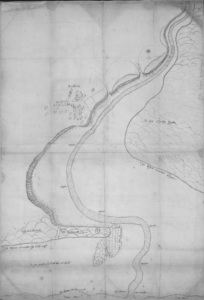
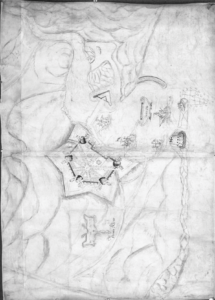
Chapter 3’s focus was on Cartography and how King Henry and the British used treaties and their power to enact laws upon the Boulonnais along with the use of maps to benefit Henry VIII’s occupation of the Boulonnais lands. As stated in the second paragraph by William Palmer, the occupation and conquest in the area put significant financial strain on the British people and played a factor in the Treaty of Camp, the people back home did not want to be involved in conflict in France. So, Henry agreed to give the area back to the French after a period of eight years in exchange for money, although evidence shows that Henry planned to keep the territory for longer, if not permanently. Mapping was another way that Henry and the British ruled over the area, they would change the landscape in the Boulonnais to support their occupation. In the figure below, what you see is the village of Ambleteuse, the picture shows the village which contains a church and 32 houses. The figure after that is when the church and the surrounding houses were destroyed and replaced by a large fortress.  


Both maps were made by John Rodgers, and they show how the area was developed and changed under Henry VIII, it went from containing housing and a church to becoming New Haven, a military stronghold that helped the British keep control of the Boulonnais.  

In the next chapter, it discusses the British Settlement in the Boulonnais which had been started in the previous chapters.  

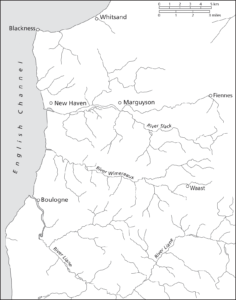
The above photo shows English Settlements in France if you look closely at the above figure, you will note that all settlements by the British were either on the coast of France or had direct access to a river. This was because the British would use waterways to transport goods and men to and from locations. The lands that came under English rule, cultivation of the land played a significant role in the success of the colonies that Henry set up, without proper cultivation of the land, “As part of its efforts to encourage the cultivation of land, the privy council set limits on the number of animals those people given lands in the Boulonnais were permitted to transport from England.”3 These themes would continue in the following chapters and would lead to the author’s central point that the occupation of Boulogne under King Henry VIII was the start of English imperialism and was a pivotal moment and action late in his lifetime that would set up England under his children.  

So, in conclusion, the strength of Neil Murphy’s book was that he showed both sides of the story, he showed those that agreed with Henry’s decisions and those that did not agree, and he then provided his own educated, scholarly opinion on what was going on and what was going on. He also was able to detail how Henry’s conquest in France during the 1540’s would be echoed later when England went into Ireland. The weakness of the book in my own opinion was that Murphy tried to cover so much in this book that details were missing, there is so much information that is being given to you that you are almost forced to accept what the author was saying and some of the sources that he (Murphy) used didn’t seem to originally be in English so the translations were difficult to understand, so I had trouble understanding the context of the quote or if it was accurate


Reviewed by Vincent Cervone, Graduate Student at George Mason University. 

Immigrant England by Ormrod, et al. — comments

Immigrant England shows the kinds of insights that can be gained from careful use of bureaucratic records, tax records in this study. This kind of “digital humanities” project allows estimates of the scale of immigration, the kinds of people who came to England in the roughly 250 years after 1300, where they went, and what kinds of work they did. Apparently, few formal narrative records of immigration exist for this period. But large numbers of records of the taxes imposed on these “aliens” have survived. Ormrod, et al., (hereafter just Ormrod) collected these archival documents and transformed them into a usable research tool Our reviewers this week have discussed the authors, the data sources, and the online database they created. Ormrod’s book provides one example of how to use the database they created.

England needed immigrants during this period because so many people in England in the 14C died from the bubonic plague. Demand for labor, particularly skilled labor, was high and the supply of workers was low. Unsurprisingly, some workers from the less-affected parts of Europe were motivated to travel to England. What Ormrod found was that one type of immigrant was a young artisan who had completed his apprenticeship but had not yet formed a relationship with a master. These medieval proto-journeymen from continental Europe—mostly, but not exclusively, from the Low Countries, France, and the Western “German” principalities of the old Holy Roman Empire—commonly took a “wanderjahr” when they traveled from town to town working in one or more workshops as they went. Some of these new journeymen spent their Wanderjahr in England. Master craftsmen opened workshops and unskilled workers, too, saw opportunities.

Ormrod shows that English guilds were ambivalent about these immigrants: some resented the competition, but others welcomed workers. Restrictions on immigrants were ordered, but enforcement was uneven. Immigrants with skills sought by the wealthy and well-connected (e.g., goldsmiths) often found a way to avoid the more onerous restrictions. Some became de facto citizens or “denizens” through a kind of naturalization process.

Although different type of immigrants settled in clusters, nearly all parts of England had some immigrant population. But immigrants comprised only a small part of the population. Refugees from as far away as Turkey settled in London in the last part of the 15C after the Ottoman Empire defeated the Byzantine Empire.

The digital researchers—and those among them who used their immigrant database to prepare  the book under review—have shown us something of this long-gone time and place. Another relatively unknown part of our past has been recovered, with the prospect of more to come.

Comments on Reviews of Immigrant England

I concur with Mathew’s and Emily’s implicit assessments that Immigrant England is a foundational text for historians studying English economic and social history during the period 1300 to 1550. As they note, the work makes excellent use of a rare, relatively robust, untapped database of contemporaneous records that includes alien subsidy (poll tax) records and letters of denization, supplemented by contemporaneous statutes, and other materials. As Emily notes, the underlying database is publicly available and the authors invite the community to build on their research, which Berry does. Accordingly, it is useful that the authors were are clear as to methodologies used to assess the data, for example associating high status with the ability of immigrants to pay for denizenship (26, 138), and the limitations of the data sets, for example where they deduce the numbers of immigrants in England. (Chapter 3) As Emily notes, the authors succinctly sketched background information on the “golden age of the English laborer,” Black Death, terminology (Chapter 1), guilds, English common law and other items to make their analysis of social and economic conditions meaningful to the general reader.  However, the work is clearly intended for a scholarly audience, and presumes some prior knowledge of regimes and events such as the Hundred Years War, Henry’s VIII’s excursion in Boulogne, Phillip the Good etc. (140) A strong argument, noted by Mathew, is violence against aliens was relatively rare and motivated by economic pressures rather than xenophobia. (chapter 10) The authors convincingly argue the “alien problem” in the latter fifteenth century was “invented and managed by Londoners,” especially the Guilds and often met by the central government’s “gesture politics”. (31-36). Chapter 6 is insightful with a focus on the high skills, new products, and technologies immigrants brought into fashion and other industries, and the “pull factors” drawing them to England. Berry’s article builds on this work and examines the acceptance of alien Goldsmiths.

Ormrod Review: Immigrant England

Ormrod, W. Mark, Bart Lambert, and Jonathan Mackman. Immigrant England, 1300-1550. Manchester: Manchester University Press, 2019.


The general notion that the Middle Ages were a time of static experience for the people living through them is an idea that is countered by W. Mark Ormrod, Bart Lambert, and Jonathan Mackman in Immigrant England, 1300-1550, their examination of the immigrant experience in England through the end of the medieval period. The conclusions they are able to draw propose that England during this time period was a “viable – and in many cases a positively attractive – place to move to” for foreigners seeking opportunity (37). The work is the result of a collaboration among Ormrod, Professor of History at the University of York, who led the project, and Lambert and Mackman who assisted with research. The book is connected to a larger research project funded by the Arts and Humanities Research Council of the United Kingdom that produced a research database and website (www.englandsimmigrants.com), where one can access and study the raw data on which the book is constructed.

The foundation of the work rests primarily on two types of documentation, pulling heavily from the files of the Exchequer and Chancery courts. First, the authors used records of a special tax known as the alien subsidy, which was applied to foreigners residing in England and was collected at different times between 1440 and 1487. The most important aspect of the subsidy was that it served as a “crude form of alien registration” (6), thereby providing a crucial resource to researchers as to how many immigrants were in England during the span in which the subsidy was applied, where they came from, and what type of work they did. While there is much inconsistency in the documents, tax officials many times recorded the nationality of aliens, and the researchers were also able to draw conclusions about origins based on the recorded surnames of aliens. Second, the authors collected letters of denization which allowed foreigners who intended to stay in England the rights to use English courts and to hold property in return for swearing an oath of fealty to the king of England. While denization was never widely used, it does provide information on the backgrounds and activities of immigrants.

The findings provided by these sources show that immigrants were coming to England from a wide variety of places, from both within the British Isles – Wales, Ireland, and Scotland, and from overseas locales such as France, Italy, and the Low Countries. And while there were higher concentrations of immigrants in the larger English cities, the records show that immigrants were living in every corner of the country, even in most rural areas. The authors note this as an important finding, for while the degree of interaction varied, “virtually all the indigenous population of England had some degree of personal knowledge of foreigners” (69). The finding also suggests a high degree of mobility in the British Isles and Europe, and a robust degree of migration that popular views may not associate with this time period. Nearly all native English people, even those who lived in rural communities, would likely have experienced some level of interaction or relationship with foreigners. The authors additionally attempt to illuminate groups that are often ignored in most existing historiography, such as women, religious minorities like Jews and Muslims, and the low-status poor, who mostly show in the alien subsidy returns under the catch-all term ‘servant’, making it difficult to determine specific information about their circumstances. Though these groups certainly existed, little of their experience was documented, leaving their lives in the gaps of the archive. Notwithstanding the archival silences concerning women and minorities, an issue which is admittedly a larger problem within historiography in general, the evidence suggests that, overall, opportunities were limited for women and minorities, particularly if they were also immigrants.

After establishing that thousands of immigrants were in England in the late Middle Ages, the authors examine what brought them there and what they did once in England. After multiple outbreaks of the plague during the Black Death, there was major depopulation in England which caused labor shortages and resulting wage increases. Higher wages resulted in more disposable income and the appearance of a consumer economy. As more goods were produced, manufacturing increased and foreign workers were attracted by the economic opportunities of this situation, not to mention the legal benefits offered by denization. Skilled craftsmen who immigrated to England for work often employed fellow immigrants as workers, sustaining the flow of immigration. The authors detail a number of industries in which immigrant workers played a role, such as the clothing industry, building materials, and beer brewing. At times, the prevalence of immigrant craftsmen and merchants, and the popularity of their goods, caused tension between them and native workers. The authors describe several instances when the tension between immigrants and English natives boiled over into violence in order to make the point that violent outbursts of this kind were relatively rare and were not the result of pervasive anti-alien sentiment, but arose more from general economic and political unease that was occasionally directed toward immigrants.

The work of Immigrant England is impressive due to the amount of knowledge it is able to draw from the alien subsidy records and other associated government documents. The majority of the book uses these documents to delve into the immigrant experience with illuminating results, but perhaps a minor critique of the book could be made with the last few chapters, focusing on the social and cultural experiences of immigrants, which while certainly important, seem to feel a bit like a different book. That said, the chapters do help fill out the picture of immigrants in England, and they allow the authors to show how the interactions of official institutions with aliens and immigrants were perhaps some of the first glimmerings of nationalism, and in hindsight could be seen as a step in the development of the nation-state. The official tax records of the alien subsidy are a good example of the type of categorization that goes along with nationalist thought, i.e., who is English, and who is not English.

Immigrant England seems to skew toward being intended for more serious scholars as opposed to a general readership. Particularly if it is read in conjunction with the database website, it gives one a great deal of insight into conditions in England, and into evolving ideas of nationalism and ‘being English’ in the last centuries of the medieval period and the transition toward the early modern era.


Reviewed by Matthew Inman, George Mason University

Ormord Review: Immigrant England

Ormrod, W. M., Bart Lambert, and Jonathan Mackman.

Immigrant England, 1300-1550.

Manchester: Manchester University Press

308 pp. £19.99, ISBN 9781526135773

Publication Date: December 2018

William Mark Ormrod was a Welsh historian who focused on the Later Middle Ages of England who passed away in 2020. Ormrod held multiple positions at University of Sheffield, Queens University Belfast, St Catharine’s College, Cambridge, and University of York before becoming a Professor of History in 1995. He also held numerous  connections and memberships at well regarded institutions such as the Royal Historical Society, a Councillor of the Pipe Roll Society, and many more.

Bart Lambert is an Assistant Professor of Late Medieval History at Vrije Universiteit Brussel (VUB). Lambert received his PhD in 2011 from Ghent University and, before joining the VUB in 2018, he worked as a post-doctoral researcher.

Jonathan Mackman is a Research Associate for the University of York. His current project is The Northern Way: the Archbishops of York and the North of England, 1304 – 1405.

This book dives into the changes that occur in England from 1300-1550 for immigrants and aliens. Some of the major question they attempt to answer are; who were these immigrants, how did the government define and regulate them, what work did these people do, and did their culture get integrated into society? The social and political landscape of defining who are immigrants, whether they are in the British Isles or overseas, was constantly shifting. The authors claim that the Hundred Years War in 1337 is one of the defining factors that “decided –​permanently, as it turned out –​whether they and their descendants would thereafter be ‘English’ or ‘French’’ (13).

From there the book is broken up into subsections. Each subsection is still discussing immigrants, but details how each group was viewed and how these biases would affect said groups. One section explains how markets became supplied with trades like shoemaking, another reflects on gender, wealth, and status in England, culture, and more. The authors use intersectionality to show how these groups of people may have been connected based on where they lived or were born, but could have been treated quite differently based on who they were.

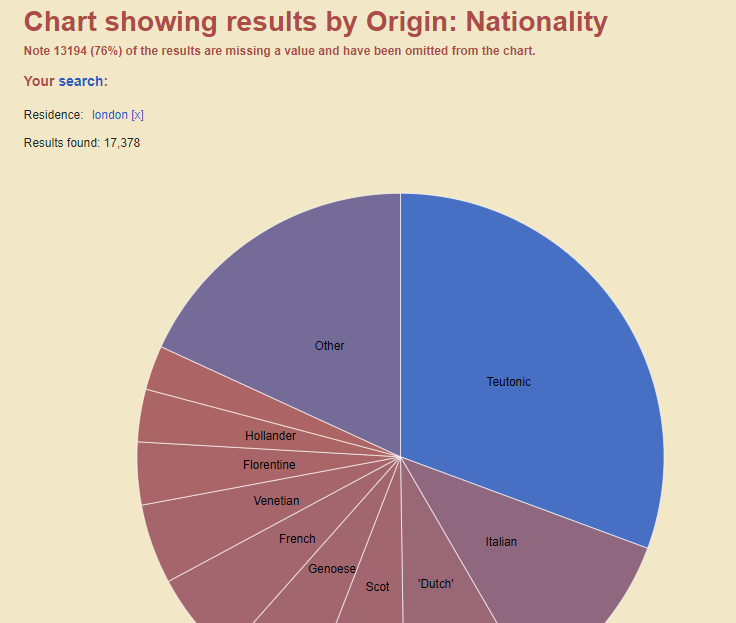
To further the work done in writing, a website was created called England’s Immigrants to display the authors’ work. This site is a database that lays out the questions asked in the project and how they came to the conclusions they did. Below is an example of how the data gave way to new information for the authors to interpret into their work.

A pie chart showing the nationality of people in London 1300-1550

Combining both the text and the data from the site, historians and the public are able to see the benefit of digital history in the field. Using historians with a social lens versus an economic one shines well in this example as jobs, labor, and gender are all shown to have an affect on aliens, the government, and society at large. This work is also dedicated to the explosion of record keeping that begins in the 13th century (5). There is a recognized bias with these records but they are still numbers that were not had before, giving hard evidence to work from. It took almost 50 years after the first notice of them to see how the field of history could use them.

As far as the way that this is written, this work could still be read and further used by many. However, late medieval and early modern historians or students would benefit from this the most. This adds to the first strength of the work, it is easy to jump into and comprehend. In the introduction, Ormrod et al. take the time to define what they mean when using the term alien, before and after outlining historical markers for the audience to follow. There are references to events that the authors feel it is unnecessary to cover in detail, but still mention as a factor to the social and political changes. One example is when the authors had summarized the flow and effects the Black Death had on society in 1348 which continued until the end of 1500’s. They do not explain the Black Death in extensive detail, but reference how it affects immigrants. To explain some of the opportunities afforded to these people, the authors mention “Laws were passed to make it easier for aliens involved in trade to maintain their commercial interests in England; special measures were taken to draw in people with particular skills; and exemptions were readily granted from the periodic threats to expel enemy aliens during times of war.”(4).

This is counted as one of the strengths of the work because it keeps it from becoming to bogged down in the weeds. One place where the text could use some work is finding a more systematic way to discussing events that affect all of the chapters. There are topics, like “Husbandmen, yeomen and gentlemen” in the chapter Wealth, status, and gender could have fit better in Supplying the market when discussing different jobs had by these immigrants, then referenced back in the conversation about status. This is a difficult distinction to make, especially with how interconnected these issues are, and does not fully hinder the work but makes it a bit awkward.

Overall, this book and website are great works that supply the field with an in-depth look at late medieval and early modern England from the bottom up and top down. Being able to see how both the immigrants and the government worked against and with each other respectively shows just how confusing it was for the developing society then and people today. This also is a great example of how interdisciplinary work from the political and economic sides of the field can work together to uncover more within a subject than previously thought.

Reviewed by Emily Meyers, Digital Research Assistant at the Roy Rosenzweig Center for History in New Media at George Mason University.